Grappling leaderboard
Control Time Kings
Filters All divisions · All time · Men












UFC fighters with the most total octagon control time. Minimum 3 fights with recorded stats.
About UFC Control Time Statistics
Control time measures how long a fighter maintains dominant position over their opponent during a fight. It is one of the most important grappling metrics in MMA, directly influencing judges' scorecards under the unified rules.
How Control Time Is Measured
Octagon control time is tracked per round by UFC statistics providers. A fighter accumulates control time when they maintain a dominant position such as top mount, side control, back control, or clinch control against the cage. This leaderboard aggregates total control time across all recorded fights.
What This Leaderboard Shows
- Total Control Time: The cumulative time a fighter has spent in controlling positions across all recorded UFC fights.
- Per-Fight Average: Average control time per fight, highlighting fighters who consistently dominate regardless of career length.
- Minimum 3 Fights: Only fighters with at least 3 fights with recorded stats are included to ensure statistical relevance.
- Division Filter: Selecting a division counts only the control time a fighter accumulated in bouts contested at that weight, not their whole career. A fighter who moved up carries their old totals with them everywhere else; here they do not.
Control time data is updated after each UFC event. Fighters who excel in control time are typically elite wrestlers and grapplers who can dictate where the fight takes place.
Limits worth knowing
Control time records position, not productivity. The clock runs the same whether a fighter is passing guard and landing ground strikes or simply holding an opponent against the cage doing very little, so a large total is evidence of grappling command rather than proof of an effective performance. Judges reward damage as well as control, and fighters near the top of this board have lost rounds they controlled.
The measurement itself involves judgement. A statistician decides when dominant position begins and ends, so brief scrambles, contested clinches and moments where neither fighter is advancing can be recorded slightly differently from one bout to the next. Per-round statistics exist for roughly 8,750 of the 8,800-plus bouts in our database, and the totals are cumulative, so long-tenured fighters have a structural advantage over the per-fight average.
Read it beside takedowns landed, which shows how the position was won in the first place, and the ELO ratings, which weight results by the standard of opposition. Individual breakdowns live on the fighter profiles, and the wider UFC statistics hub covers the rest of the grappling picture.
Frequently Asked Questions
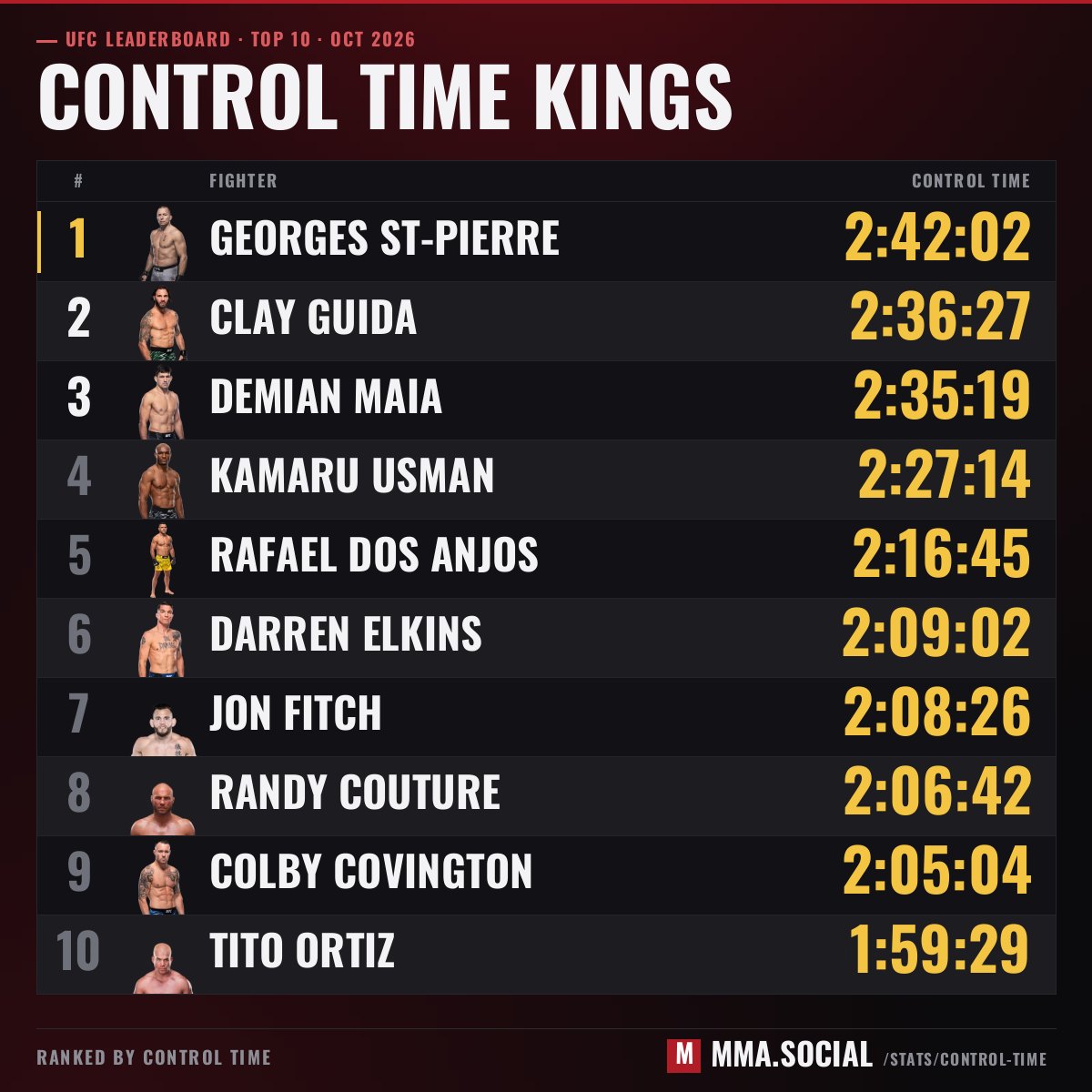
Control Time Kings: top 10
The top 10 as one image. Free to share, updated after every UFC card.