Most 10-8 Rounds in UFC History

76
Nassourdine Imavov
Nassourdine Imavov in 1 fight
1 ROUNDS
77
Gilbert Burns
Gilbert Burns in 1 fight
1 ROUNDS
78
Ian Machado Garry
Ian Machado Garry in 1 fight
1 ROUNDS
79
Lerone Murphy
Lerone Murphy in 1 fight
1 ROUNDS
80
Brandon Moreno
Brandon Moreno in 1 fight
1 ROUNDS
81
Joseph Benavidez
Joseph Benavidez in 1 fight
1 ROUNDS
82
Gray Maynard
Gray Maynard in 1 fight
1 ROUNDS
83
Marlon Vera
Marlon Vera in 1 fight
1 ROUNDS
Advertisement
84
Cody Garbrandt
Cody Garbrandt in 1 fight
1 ROUNDS
85
Tatsuro Taira
Tatsuro Taira in 1 fight
1 ROUNDS
86
Yushin Okami
Yushin Okami in 1 fight
1 ROUNDS
87
Stephen Thompson
Stephen Thompson in 1 fight
1 ROUNDS
Advertisement
88
Caio Borralho
Caio Borralho in 1 fight
1 ROUNDS
89
Josh Koscheck
Josh Koscheck in 1 fight
1 ROUNDS
90
Robbie Lawler
Robbie Lawler in 1 fight
1 ROUNDS

Your move

2026 Stats

About Most 10-8 Rounds in UFC History

Rounds at least two of the three judges scored 10-8 - the sport's marker of a one-sided five minutes

This leaderboard ranks UFC fighters by how many rounds the judges scored 10-8 — the score reserved for a round one fighter did not just win but dominated. Around 88% of all judge scorecards in our records contain no 10-8 at all, which is what makes the figure worth counting.

How the rounds are identified

Where the official round-by-round judges' cards are on file, a 10-8 is read straight off them, with any point the referee deducted put back first so a docked point is not mistaken for a dominant round. Where only each judge's total is on file, it is derived from the total. A card built entirely from 10-9 rounds sums to 19 points per round; every 10-8 costs the pair one point, so the shortfall against that baseline is the number of 10-8 rounds on the card. A fighter is credited only where at least two of the three judges scored one, so a lone outlying judge cannot put a round on this board.

What this board cannot see

Two limits are worth stating plainly. Where only a judge's total is on file, a referee's point deduction costs it one point in exactly the same way a 10-8 does, so a few of those rounds may be deductions; the official round-by-round cards, which nearly every decision since 2020 has and older ones are gaining, settle it. And a fight that ends by knockout or submission produces no scorecards at all, so the most one-sided rounds in UFC history — the ones that ended early — are invisible here by definition. Read it as a board about dominant judged rounds, alongside most decision wins, most rounds fought and most split-decision losses for the rest of the scorecard picture.

Frequently Asked Questions

What is a 10-8 round?
The score a judge gives when one fighter does not merely win a round but dominates it — overwhelming damage, control, or both. Most rounds are scored 10-9. A 10-8 is the judges saying the five minutes were one-sided, and roughly nine in ten UFC scorecards contain none at all.
Where do these numbers come from?
The judges' scorecards from every UFC decision with a winner (drawn decisions are not included). Where the official round-by-round cards are on file — nearly every decision since 2020, with older ones being added — a 10-8 is read straight off them. For the rest we derive it from each judge's total: a card made up only of 10-9 rounds adds up to 19 points per round, and each 10-8 costs the pair exactly one point. A fighter is credited with a 10-8 when at least two of the three judges scored one — a panel majority, not a single judge's opinion.
Could a point deduction be counted as a 10-8 by mistake?
On fights with the official round-by-round cards, almost never. A judge's card shows each round after the referee's deduction, so a docked point can make a 10-9 look like a 10-8, or a 10-8 look like a 10-9. We put the docked points back before counting: the winner of a round always gets 10, so a card where nobody has 10 has lost a point, and where the fight's result notes who was docked we use that too. A round the cards still can't settle is not counted. On older fights where only each judge's total is on file, a deduction costs a point exactly as a 10-8 does; noted deductions are taken off first, but an unnoted one can still slip through until that fight's official cards are added.
Why are famous finishers missing from this board?
Because a fight that ends inside the distance has no scorecards at all. A fighter who batters someone for one round and knocks them out in the second leaves no 10-8 behind, however one-sided that first round was. This board can only see rounds that were actually judged, so it favours fighters who win dominant decisions over fighters who finish — which is why the names near the top are mostly grinding wrestlers rather than knockout artists.
Why does a fighter with fewer fights rank above one with more?
Ties are broken by how few fights the rounds came from, because four 10-8 rounds across two fights is a more emphatic record than four across four. The caption under each name shows the number of fights involved.

Every UFC statistics leaderboard

Stats Hub
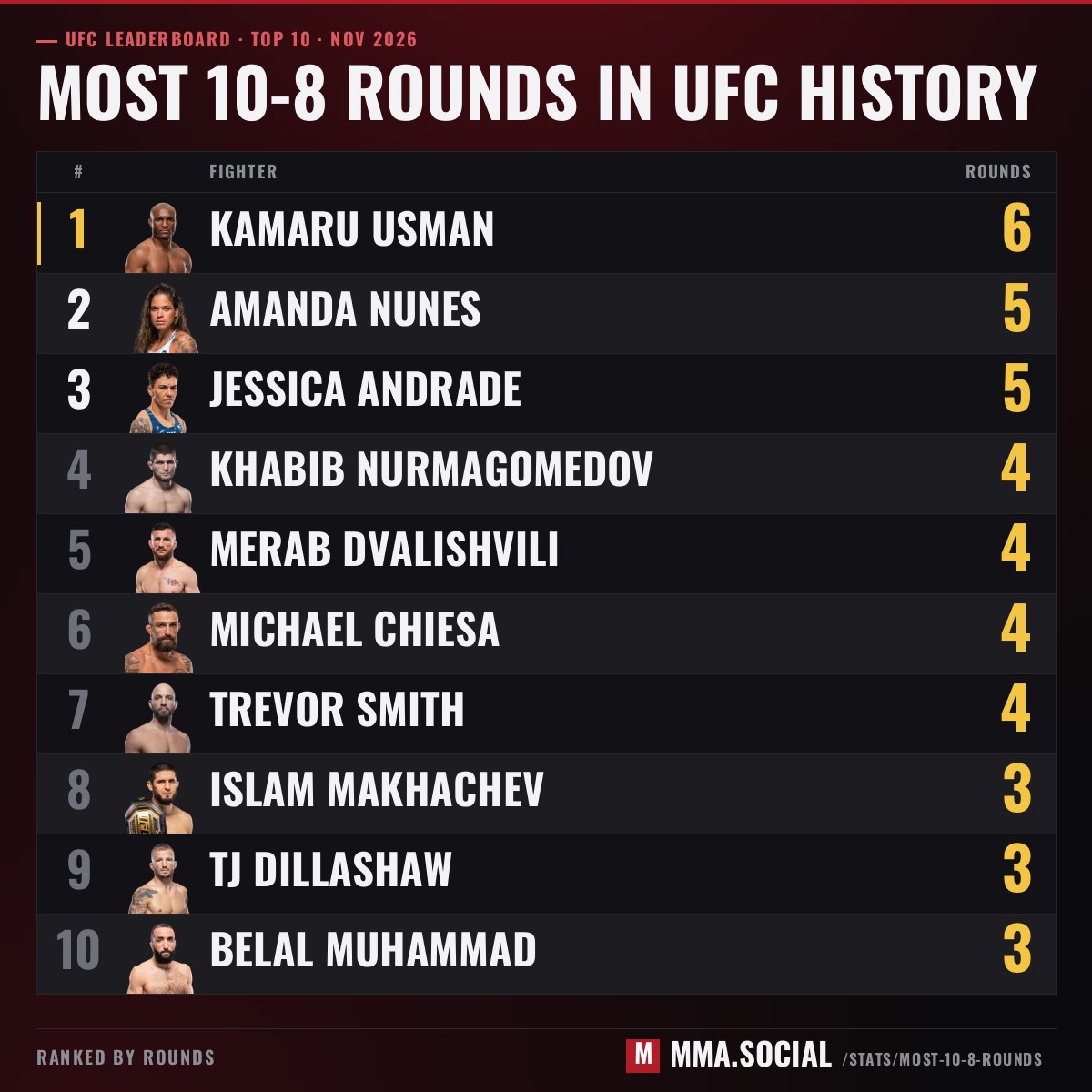
Most 10-8 Rounds in UFC History - top 10 (MMA.SOCIAL): 1. Kamaru Usman (6), 2. Amanda Nunes (5), 3. Jessica Andrade (5), 4. Khabib Nurmagomedov (4), 5. Merab Dvalishvili (4), 6. Michael Chiesa (4), 7. Trevor Smith (4), 8. Islam Makhachev (3), 9. TJ Dillashaw (3), 10. Belal Muhammad (3)
Most 10-8 Rounds in UFC History - top 10, updated Nov 25, 2026.
Share image

Most 10-8 Rounds in UFC History: top 10

The top 10 as one image. Free to share, updated after every UFC card.