Toughest Schedule in UFC History

MMA.social ELO — our own rating, not a UFC ranking.

1
Zhang Weili
Zhang Weili
1,106 AVG. OPPONENT ELO
2
Rose Namajunas
Rose Namajunas
1,098 AVG. OPPONENT ELO
3
Manon Fiorot
Manon Fiorot
1,092 AVG. OPPONENT ELO
4
Julianna Pena
Julianna Pena
1,091 AVG. OPPONENT ELO
5
Valentina Shevchenko
1,078 AVG. OPPONENT ELO
6
Alexa Grasso
Alexa Grasso
1,076 AVG. OPPONENT ELO
7
Erin Blanchfield
Erin Blanchfield
1,066 AVG. OPPONENT ELO
8
Germaine de Randamie
1,056 AVG. OPPONENT ELO
Advertisement
9
Jessica Andrade
Jessica Andrade
1,053 AVG. OPPONENT ELO
10
Holly Holm
Holly Holm
1,053 AVG. OPPONENT ELO
11
Amanda Nunes
Amanda Nunes
1,047 AVG. OPPONENT ELO
12
Joanna Jedrzejczyk
Joanna Jedrzejczyk
1,046 AVG. OPPONENT ELO
Advertisement
13
Tatiana Suarez
Tatiana Suarez
1,045 AVG. OPPONENT ELO
14
Carla Esparza
Carla Esparza
1,034 AVG. OPPONENT ELO
15
Amanda Lemos
Amanda Lemos
1,033 AVG. OPPONENT ELO

Your move

2026 Stats

About Toughest Schedule in UFC History

Average rating of every opponent faced, as it stood on fight night - minimum 10 UFC bouts

Every fighter's record is really two numbers: how often they won, and who they had to beat. This board is the second one. For each UFC bout we take the opponent's ELO rating as it stood going into that fight, average it over the career, and rank by that figure. The rating is MMA.SOCIAL ELO - our own rating, not an official UFC ranking. A high number means a career spent against good people while they were good. It says nothing about the results, which is the point - it is the difficulty of the road, measured separately from how far along it anyone got.

Measured on the night, and why there is a floor

Each opponent is scored at the rating they carried into that particular bout, not at their career best and not at what they are worth today. That is the difficulty the fighter actually faced. Scoring by career peak - which this board used to do - quietly rewards catching someone early: a win over a 6-0 prospect who became champion three years later counted exactly as much as sharing a cage with that champion in their prime, and it inflated the careers of everyone who fought a future great on the way up. The 10-bout minimum does heavier lifting than a floor usually does, because an average is far easier to distort with a small sample than a total is. Without it, this page would be led by whoever drew a ranked opponent in their first two appearances. Only bouts with a result count, so a booked fight never moves the average.

Reading the figure

The site-wide ELO baseline is 1,000, so the number is best read as a distance above a debutant. Most of the roster averages close to that baseline, because most of the roster is. The top of this page is a different sport: those careers were spent almost exclusively against ranked opposition and former or future champions. Every row's figure moves if the rating engine is retuned, because the ratings and this board must describe the same history.

Strength of schedule pairs naturally with the boards that measure what came of it. Compare it against the MMA.SOCIAL ELO rankings for where a fighter ended up, most title fights for how often the road led to a belt, and most wins for the raw return. A fighter high on this page and low on those had the hardest possible career; one high on both had the best. The full collection lives on the UFC stats hub.

Frequently Asked Questions

How is a toughest schedule measured?
For every UFC bout a fighter has contested we take the opponent's ELO rating as it stood going into that bout, and average it over the whole career. It is a measure of the road, not the result: winning or losing the fight does not change the number. The rating is MMA.SOCIAL ELO, our own results-based rating rather than an official UFC ranking, on a baseline of 1,000 - so an average of 1,200 means the typical opponent was worth about 200 points more than a debutant on the night they met.
Is this the opponent's rating on the night, or their career best?
On the night. Each bout is scored using the opponent's rating as it stood when the cage door closed, which is the difficulty that was actually in front of the fighter. This board previously used each opponent's career-best rating, and that flattered anyone who caught a future champion early: beating a 6-0 prospect scored the same as facing that same fighter in their prime years later. A fighter's own record is frozen the moment a fight ends, and so is the calibre of the person they beat.
Why does a fighter need 10 UFC bouts to appear?
Because this is an average, and averages are trivially gamed by a small sample. Without a floor the board is won by whoever happened to draw a ranked opponent in their first two appearances, on a sample of two. Only bouts that have actually been fought count toward the ten - a booked or cancelled bout adds nothing.
Does a tough schedule mean a better fighter?
No, and the board is not ranked to suggest it. A hard schedule is what happens to contenders and champions, who are matched upward, and to gatekeepers, who are fed prospects on the way up. It is also what happens to a fighter who keeps losing to good people. Most of the roster averages close to the 1,000 baseline, so a figure well above it is a genuinely elite run of opposition - but read it next to the fighter's record, not instead of it.

Every UFC statistics leaderboard

Stats Hub
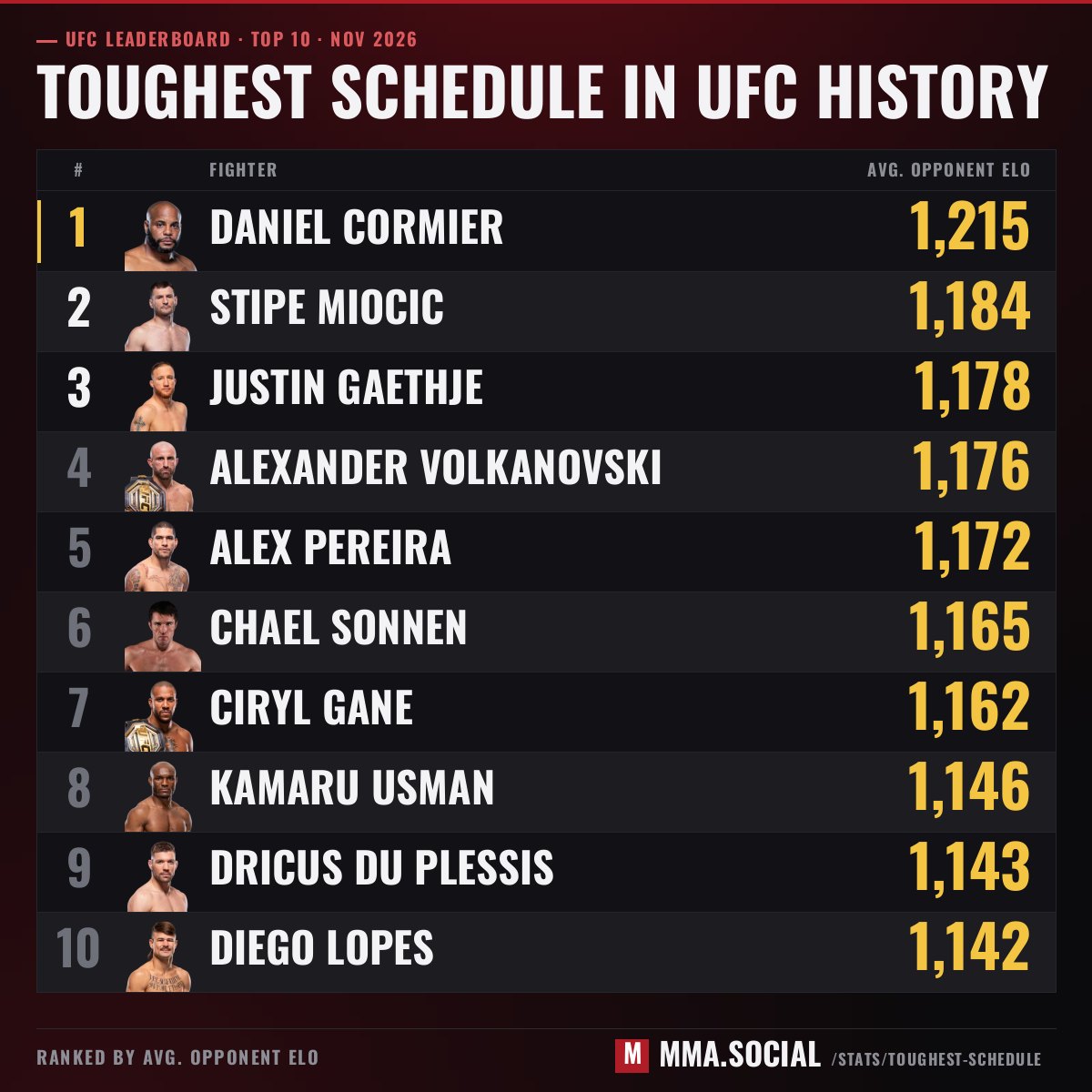
Toughest Schedule in UFC History - top 10 (MMA.SOCIAL): 1. Daniel Cormier (1,215), 2. Stipe Miocic (1,184), 3. Justin Gaethje (1,178), 4. Alexander Volkanovski (1,176), 5. Alex Pereira (1,172), 6. Chael Sonnen (1,165), 7. Ciryl Gane (1,162), 8. Kamaru Usman (1,146), 9. Dricus Du Plessis (1,143), 10. Diego Lopes (1,142)
Toughest Schedule in UFC History - top 10, updated Nov 24, 2026.
Share image

Toughest Schedule in UFC History: top 10

The top 10 as one image. Free to share, updated after every UFC card.