MMA.SOCIAL

Install MMA.SOCIAL

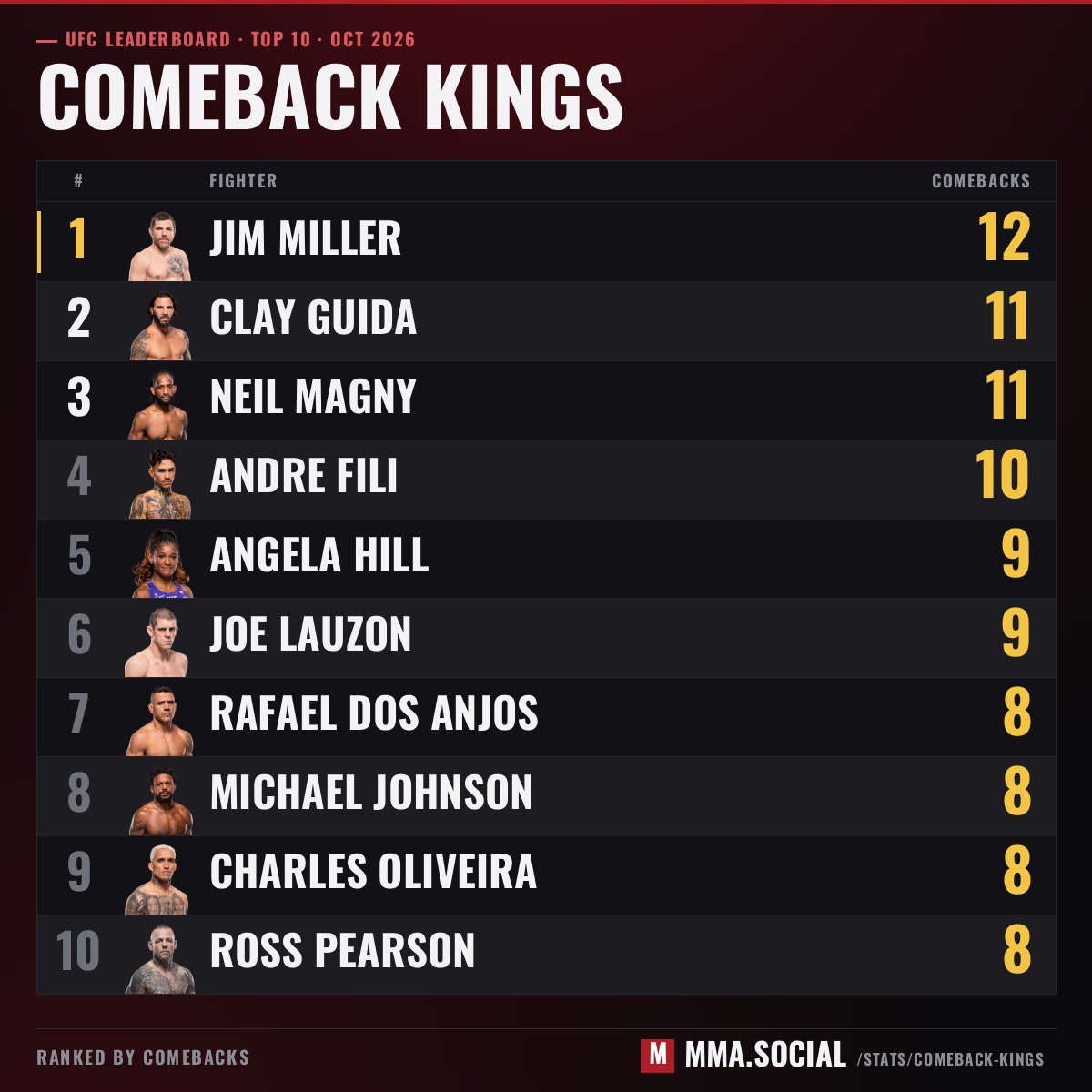
    Comeback Kings

    16
    Loopy Godinez
    Loopy Godinez
    4 comebacks
    17
    Alexa Grasso
    Alexa Grasso
    4 comebacks
    18
    Holly Holm
    Holly Holm
    4 comebacks
    19
    Virna Jandiroba
    Virna Jandiroba
    4 comebacks
    20
    Amanda Lemos
    Amanda Lemos
    4 comebacks
    21
    Jennifer Maia
    Jennifer Maia
    4 comebacks
    22
    Sara McMann
    Sara McMann
    4 comebacks
    23
    Roxanne Modafferi
    Roxanne Modafferi
    4 comebacks
    Advertisement
    24
    Lauren Murphy
    Lauren Murphy
    4 comebacks
    25
    Raquel Pennington
    Raquel Pennington
    4 comebacks
    26
    Elise Reed
    Elise Reed
    4 comebacks
    27
    Karol Rosa
    Karol Rosa
    4 comebacks
    Advertisement
    28
    Bruna Brasil
    Bruna Brasil
    3 comebacks
    29
    Priscila Cachoeira
    Priscila Cachoeira
    3 comebacks
    30
    Liz Carmouche
    Liz Carmouche
    3 comebacks
    47Fighters
    9Most Comebacks
    2026 · All-Time

    Most UFC wins in the very next fight after a loss

    About Comeback Kings

    This leaderboard measures resilience: how many times a fighter answered a loss with an immediate win in their very next bout. We rebuild every career fight-by-fight in chronological order and count each bounce-back, so the names at the top are the fighters who simply refused to let a setback become a slide. Only bouts recorded in our UFC database are in the sequence.

    Choosing a division counts only the comebacks whose winning fight happened at that weight class, rather than filtering by the fighter's current division and printing their career total beside it — otherwise a fighter who moved up would be credited in one division for bounce-backs completed in another. Each row on a division view also shows how much of the career total it represents, and the divisions add up to that total exactly.

    What the count rewards, and what it does not

    A comeback here is a strictly mechanical thing: a loss followed immediately by a win. That makes the number honest and easy to check, but it also means it rewards two different qualities at once. A fighter can rank highly because they are exceptionally hard to keep down, and a fighter can rank highly simply because they have fought a very long time and lost often enough to have many chances to bounce back. Nobody accumulates a large tally without both losing and winning a lot, so the board is as much a longevity list as a resilience list. It also treats every bounce-back the same: answering a title-fight defeat against a champion counts once, and so does a win over a short-notice replacement. Draws reset the sequence rather than continuing it, and a no contest is skipped entirely so that whatever result came before it still stands.

    Losing is part of every elite career — how you respond is the tell. Cross-reference with our longest losing streaks (the opposite trait) and most wins leaderboards to see who turned adversity into momentum, use the ELO rankings to judge the quality of the opponents behind a tally, and open a fighter profile to walk the actual sequence fight by fight. The rest of our UFC statistics cover the other side of a career.

    Frequently Asked Questions
    What is a comeback counted here?
    Every time a fighter loses and then wins their very next bout, that's one comeback. We rebuild each career in chronological order and tally how often a fighter answered a defeat with an immediate win.
    Does this count fights outside the UFC?
    No. The sequence is rebuilt from bouts recorded in our UFC database, so a fighter's results elsewhere neither create nor break a run. Bouts that have been announced but not yet fought are left out of the sequence entirely.
    What does the division filter do?
    It counts only the comebacks whose winning fight took place in that weight class. A fighter who moved up appears under each division they bounced back in, carrying only the comebacks they actually completed there, and each row shows how many of their career total that represents. The divisions add up to the career figure exactly.
    Why is this a good measure of mental toughness?
    Losing is inevitable at the elite level; responding to it is what separates contenders from the rest. Fighters at the top of this list refused to let a defeat snowball — they reset and won the next time out again and again.
    Does a draw count as a loss for the bounce-back?
    No. Only a win immediately after a loss counts. A draw resets the sequence, and a no-contest is skipped entirely so it preserves whatever result came before it.

    Explore More Stats

    From bounce-backs to the greatest win streaks ever

    Stats Hub