Highest Finish Rate in UFC
Filters All divisions · All time · 10+ fights














Your move
About Highest Finish Rate in UFC
Share of a fighter's UFC WINS that ended by KO/TKO or submission (min. 5 wins)
Finish rate answers one of the most fundamental questions a fan can ask about a fighter: when they win, do they end it themselves, or do they leave it up to the judges? On this page we calculate it by combining every KO/TKO win with every submission win and doctor's stoppage, then dividing that total by the fighter's UFC wins. A fighter sitting near the top of this leaderboard is someone who, more often than not, walks out of the cage having put their opponent to sleep, made them tap, or forced the referee to step in.
The ranking only includes fighters with at least 5 UFC wins and at least one finish, which filters out flash-in-the-pan records and keeps the list meaningful. We sort primarily by finish percentage, and when two fighters tie we break it by the raw number of finishes, so the athlete with the deeper body of work edges ahead. That second sort matters: a 90 percent finish rate built over 20 wins tells a very different story than the same percentage over 5.
UFC bouts only, and division means the bout's division
Both halves of the ratio are counted from bouts fought in the UFC, so nothing a fighter did before signing moves the number. The division dropdown recalculates the ratio from the bouts contested at that weight class rather than filtering by the fighter's current division and printing a career percentage beside it — a fighter who moved up used to carry their whole career rate into the new division's list, describing performances at one weight as though they happened at another.
What a high finish rate actually signals
A standout finish rate is usually the fingerprint of a particular style. Heavy-handed strikers, aggressive front-runners, and elite grapplers with a relentless top game all tend to cluster near the top, because their offense is built around ending fights rather than accumulating points. It can also hint at a fighter's mentality, the ones who push for the kill rather than coasting on a lead. It is worth remembering, though, that the stat says nothing about how often a fighter actually wins; a high-variance knockout artist can rank above a steadier decision specialist.
For fans, this is one of the purest entertainment metrics in the sport. If you want to know whose fights you should never leave the room during, the names at the top of this board are the answer. Cross-reference what you find here with our ELO rankings to see which of these finishers also rank among the most successful fighters overall, or dig into individual fighter profiles to see exactly how those finishes were earned.
Frequently Asked Questions
Every UFC statistics leaderboard
Stats Hub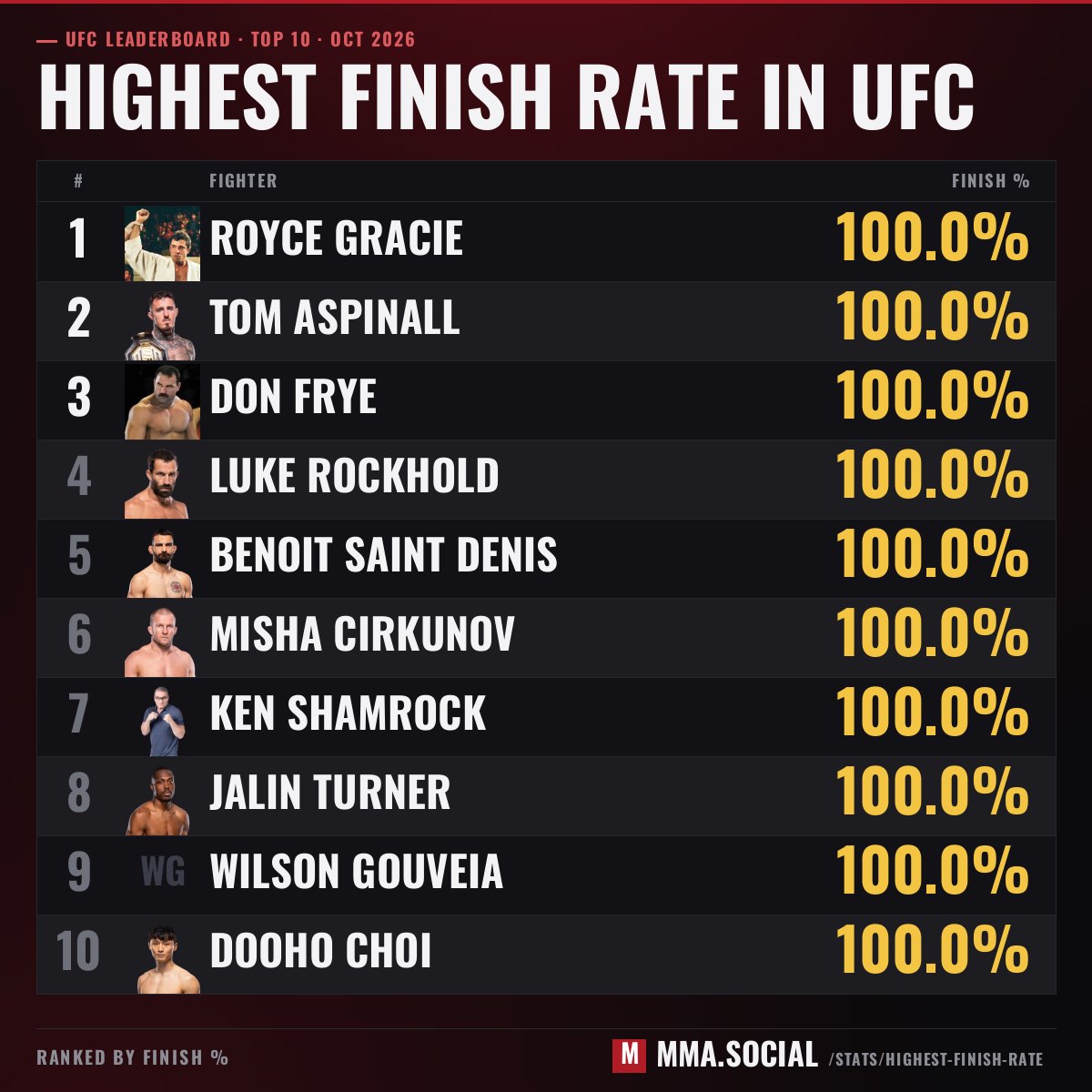
Highest Finish Rate in UFC: top 10
The top 10 as one image. Free to share, updated after every UFC card.