MMA.SOCIAL

Install MMA.SOCIAL

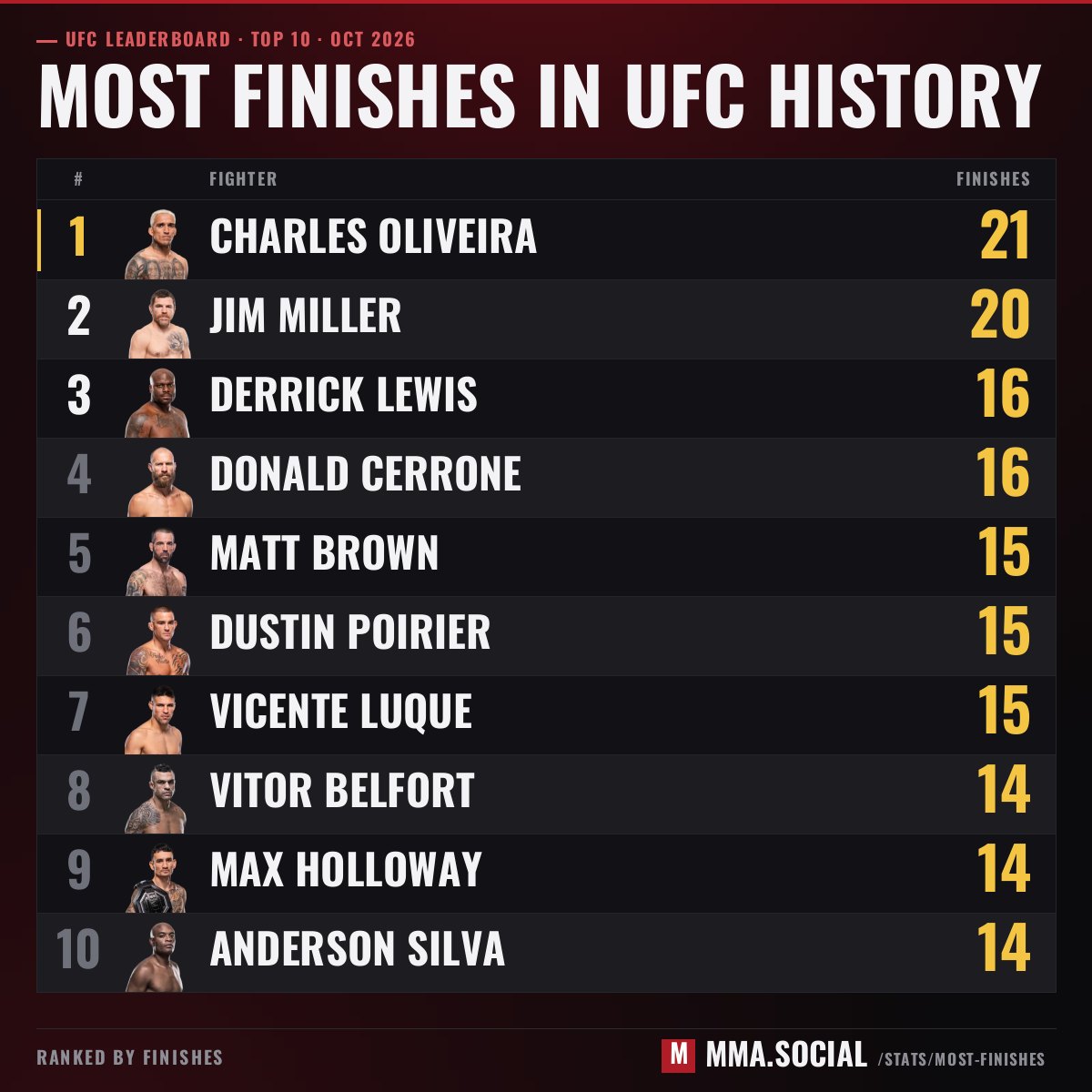
    Most Finishes in UFC History

    KO/TKO (striking finish) Submission (grappling finish)
    16
    Jon Jones
    Jon Jones
    12 finishes 6 KO 6 SUB
    17
    Nate Diaz
    Nate Diaz
    12 finishes 2 KO 10 SUB
    18
    Demian Maia
    Demian Maia
    12 finishes 1 KO 11 SUB
    19
    Gerald Meerschaert
    Gerald Meerschaert
    12 finishes 1 KO 11 SUB
    20
    Anthony Johnson
    Anthony Johnson
    11 finishes 11 KO
    21
    Thiago Santos
    Thiago Santos
    11 finishes 11 KO
    22
    Francis Ngannou
    Francis Ngannou
    11 finishes 10 KO 1 SUB
    23
    Andrei Arlovski
    Andrei Arlovski
    11 finishes 9 KO 2 SUB
    Advertisement
    24
    Neil Magny
    Neil Magny
    11 finishes 8 KO 3 SUB
    25
    Randy Couture
    Randy Couture
    11 finishes 7 KO 4 SUB
    26
    Gabriel Gonzaga
    Gabriel Gonzaga
    11 finishes 7 KO 4 SUB
    27
    BJ Penn
    BJ Penn
    11 finishes 7 KO 4 SUB
    Advertisement
    28
    Marlon Vera
    Marlon Vera
    11 finishes 7 KO 4 SUB
    29
    Ovince Saint Preux
    Ovince Saint Preux
    11 finishes 6 KO 5 SUB
    30
    Anthony Smith
    Anthony Smith
    11 finishes 6 KO 5 SUB
    100Finishers Ranked
    21Most Finishes
    657KO/TKOs
    348Submissions
    2026 · All-Time

    The career finishers — most knockouts and submissions of all time, UFC bouts only

    About Career Finishes

    This leaderboard ranks fighters by the total number of fights they've ended inside the distance — every knockout, technical knockout, and submission on their UFC record combined. It's the volume board: the sport's most reliable finishers, the fighters you tune in for because the scorecards rarely get involved. The red figure is striking finishes (KO/TKO); the cyan figure is submissions.

    Every number here comes from bouts fought in the UFC, so a fighter's regional-circuit finishes do not appear. The division dropdown re-counts the figure from the bouts contested at that weight class rather than filtering by the fighter's current division and printing a career total beside it — on the old board a fighter who moved up carried their whole career tally into the new division's list, crediting finishes made at one weight to another. Because both views read the same per-division table, the divisions add up to the career figure exactly.

    What a finish count does not capture

    A finish is recorded the same way whether it took twelve seconds or fourteen and a half minutes, and whether it came against a champion or a debutant. The total therefore says a great deal about how a fighter wins and very little about who they beat — a long career spent finishing lower-tier opposition can out-count a short one spent stopping contenders. It is also a count of wins only: a fighter who has been stopped as often as they have stopped others sits on this board with no hint of it. Doctor's stoppages are grouped with knockouts because that is how the official record classifies them, which flatters cut stoppages slightly relative to clean knockdowns. And because the figure grows with every bout, an active veteran will climb past a retired one on activity alone.

    Volume isn't the same as efficiency. A career finisher with 100 fights will out-count a young phenom who finishes almost everyone, so pair this with our highest finish-rate and KO-rate pages to separate the busy from the lethal. For single-discipline crowns, see most knockouts and most submissions.

    Advertisement

    Frequently Asked Questions

    What counts as a finish?
    A finish is any victory that ends the fight before the judges' scorecards — a knockout, technical knockout (including doctor's stoppages), or a submission. Decisions and disqualifications are not finishes. We total every KO/TKO and submission win in a fighter's recorded UFC history.
    Does this count fights outside the UFC?
    No. Every figure here is built from bouts recorded in our UFC database, so finishes a fighter scored on the regional circuit before signing do not appear. A bout that has been announced but not yet fought has no result and cannot count either.
    What does the division filter do?
    It re-counts the figure from the bouts contested in that weight class rather than showing a career total beside a division label. A fighter who moved up appears under each division they fought in, carrying only the finishes they scored there, and each row tells you how many of their career total that represents. The divisions add up to the career figure exactly.
    How is the KO / SUB split calculated?
    Each finish is bucketed by its method: strikes (KO/TKO, including doctor's stoppages) or a submission. The two numbers add up to the fighter's total finishes. It's the quickest way to see whether a finisher is a knockout artist, a submission specialist, or a genuine threat everywhere.
    Why is this a count, not a rate?
    This page rewards volume — the fighters who have simply ended the most fights. For efficiency (finishes as a share of wins), see our finish-rate leaderboards, where a fighter with fewer bouts but a higher stoppage percentage can rank ahead of the big career tallies.

    Explore More Rankings

    From career finishes to knockout power

    Most Knockouts