Grappling leaderboard
Most Taken Down
Filters All divisions · All time















The UFC fighters who have hit the mat the most — ranked by total takedowns conceded across every tracked bout, with each fighter's takedown-defense rate for context.
About Takedowns Conceded
This leaderboard ranks the UFC fighters who have been taken down the most across their tracked careers — the flip side of the takedown-leaders board. Each count is an opponent's successful takedown, tallied from the receiving end and paired with the fighter's overall takedown-defense percentage.
A big number here doesn't automatically mean weak wrestling. Many exciting strikers get put on their back often yet win anyway by threatening submissions off their back, scrambling up instantly, or simply out-striking wrestlers who spend energy hauling them down. Read the takedowns-against total together with the TDD% and the win-loss record to see the full picture.
Key Metrics Explained
- Takedowns Against: Total takedowns an opponent landed on this fighter across all fights with stats.
- Per Fight: Average takedowns conceded per bout — normalizes for career length.
- TDD% (Takedown Defense): The share of takedown attempts the fighter stuffed. A high takedowns-against total with a strong TDD% simply means opponents kept shooting.
- Division Filter: Selecting a division counts only the takedowns conceded in bouts contested at that weight, not the fighter's whole career. Every division a fighter competed in adds back up to their career total exactly.
Methodology
Takedowns conceded are computed by pairing each fighter's bout with the opponent's record of the same bout and summing the opponent's takedowns landed. Fighters need at least 3 tracked fights and 5+ takedowns absorbed to appear. All data comes from official UFC per-round fight statistics.
Limits worth knowing
The count records that a takedown was completed against a fighter, and nothing about what happened next. A fighter who is put down and stands straight back up is charged exactly the same as one who spends the rest of the round pinned underneath, so this board on its own cannot tell a momentary lapse from a genuine grappling problem. Reading it beside control time is the quickest way to separate the two.
There is also a selection effect that flatters nobody and condemns nobody. Fighters who are hard to finish stay in fights longer, face more shots and therefore concede more takedowns than a fighter with the same defensive skill and a shorter career. That is why the per-fight figure and the takedown-defence percentage sit alongside the total rather than beneath it, and why a high total with a strong defence percentage usually just means opponents kept trying.
Per-round statistics exist for roughly 8,750 of the 8,800-plus bouts in our database, so a small number of older fights contribute nothing here. A division view counts only the bouts contested at that weight, so a fighter who changed division has their total divided between divisions rather than repeated in each. For opposition-weighted standing see the ELO ratings, for the full career the fighter profiles, and for related boards the UFC statistics hub.
Frequently Asked Questions
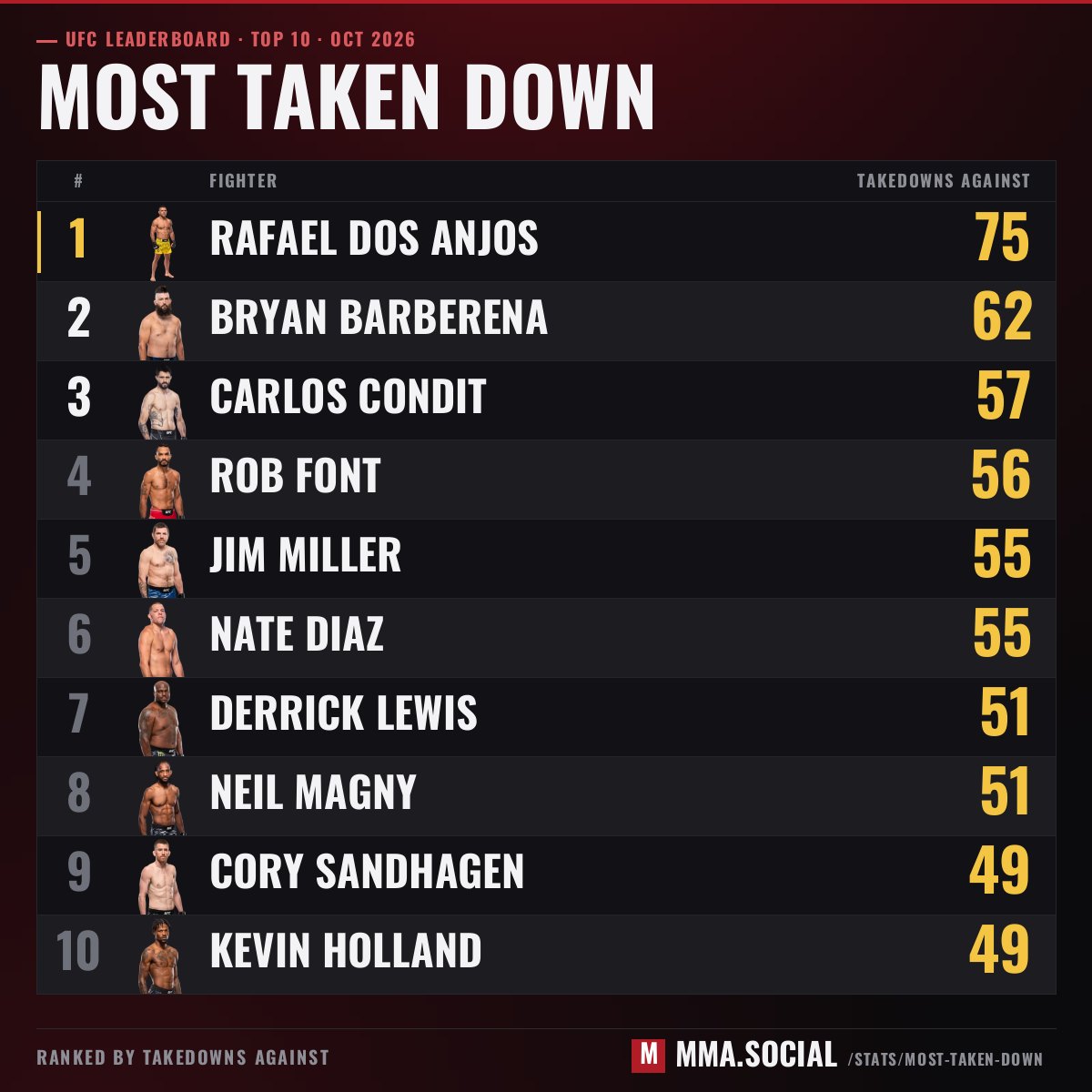
Leaderboard: top 10
The top 10 as one image. Free to share, updated after every UFC card.