Longest Layoffs Between UFC Fights

16
Joseph Morales
Joseph Morales
2,471 DAYS APART
17
Mike Brown
Mike Brown
2,465 DAYS APART
18
Pat Healy
Pat Healy
2,445 DAYS APART
19
Nick Diaz
Nick Diaz
2,429 DAYS APART
20
Roan Carneiro
Roan Carneiro
2,366 DAYS APART
21
Daniel Pineda
Daniel Pineda
2,345 DAYS APART
22
Tamdan McCrory
Tamdan McCrory
2,324 DAYS APART
23
Sean Soriano
Sean Soriano
2,309 DAYS APART
Advertisement
24
Andrei Arlovski
Andrei Arlovski
2,296 DAYS APART
25
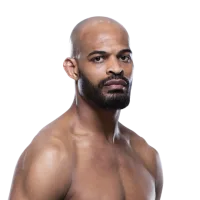
David Branch
David Branch
2,263 DAYS APART
26
Joshua Burkman
Joshua Burkman
2,261 DAYS APART
27
Ricardo Almeida
Ricardo Almeida
2,213 DAYS APART
Advertisement
28
Jesse Ronson
Jesse Ronson
2,211 DAYS APART
29
Vladimir Matyushenko
2,185 DAYS APART
30
John Alessio
John Alessio
2,178 DAYS APART

Your move

2026 Stats

About Longest Layoffs Between UFC Fights

Longest gap between two UFC bouts in one career - minimum 5 bouts, two years

This leaderboard ranks UFC fighters by the longest single gap between two of their own bouts. It is measured from one event date to the next appearance on a UFC card, so it captures one specific interval inside a career rather than its length or its busiest stretch. To qualify a fighter needs at least five UFC bouts and a gap of at least two years. The fifty longest qualifying layoffs are listed here, each row carrying the years the gap ran between. Only bouts that were actually fought count, so a booked comeback does not close a gap until fight night.

These are absences from the UFC, not from fighting

This is the most important thing to understand about the page. Our database records UFC bouts, and nothing else, so every number here measures time away from the Octagon. Most of the men near the top were fighting the whole time, often as champions somewhere else. Josh Barnett's 11.4-year gap covers a career in Pride, Affliction and Strikeforce. Dan Henderson's 9.3 years cover two Pride titles and a Strikeforce belt. Robbie Lawler spent his 8.3 years becoming a legend in EliteXC and Strikeforce, then came back and won the UFC welterweight title. Kyoji Horiguchi's 9.0 years brought RIZIN and Bellator gold. Calling any of this inactivity would be plainly wrong, which is why the word never appears on this page.

The gaps that are genuine time off are usually the more human stories: a fighter walking away, a long suspension, a serious injury, or a life that pulled them out of the sport and then handed them one more chance. What unites everyone here is the return. Because a layoff is only measurable once a later fight exists, no one lands on this board for merely having stopped — the interval has to be closed by a real bout, so every fighter listed made it back through the door.

Read this alongside the other career-shape boards to see how differently they cut the same data. Iron Man measures the span from a fighter's first UFC bout to their last, and Busiest Fighters measures the most bouts inside a single calendar year; neither can see a hole in the middle of a career, which is exactly what this page is for. Comeback Kings covers the other kind of comeback, the one inside the fight. For the wider picture, browse the full UFC stats collection or the MMA.SOCIAL ELO rankings.

Frequently Asked Questions

What counts as a layoff on this leaderboard?
The gap between two consecutive UFC bouts by the same fighter, measured in days from the first event to the next one they actually fought on. Each fighter is listed once, with their single longest gap. Josh Barnett's gap is the benchmark: 4,180 days — 11.4 years — between UFC 36 on 22 March 2002 and UFC 164 on 31 August 2013.
Were these fighters actually inactive during the gap?
Usually not, and this page never says they were. Our database holds UFC bouts only, so a gap here means time away from the Octagon, not time away from the sport. Josh Barnett fought in Pride, Affliction and Strikeforce across his 11 years off the UFC roster; Dan Henderson won Pride titles and headlined Strikeforce during his 3,403-day gap; Robbie Lawler built his reputation in EliteXC and Strikeforce during his 3,046 days; Kyoji Horiguchi held RIZIN and Bellator gold through his 3,290. Read every figure as an absence from the UFC.
Why does nobody who simply retired appear here?
Because a gap only exists once a fighter comes back. The measurement compares each bout with the one before it, so the clock since a fighter's most recent walk-out is never counted — there is no later fight to close the interval. That makes this a comeback board by construction: every qualifying fighter returned to the Octagon after their layoff. For absences still running, see days since last fight.
Does a booked comeback fight close the gap?
No. The gap closes only when the comeback bout has actually been fought. A fight that has been announced, or one that was cancelled, does not count, so a fighter returning from a long absence appears here once the comeback has a result, not the day it is booked.
What are the minimums, and why are they set there?
A fighter needs at least 5 UFC bouts and a gap of at least 730 days (two years). The bout minimum stops a short cameo either side of a long absence from topping a board about UFC careers, and the two-year floor keeps out routine layoffs for injury, contract talks or a slow matchmaking cycle. The 50 longest qualifying gaps are shown.

Every UFC statistics leaderboard

Stats Hub
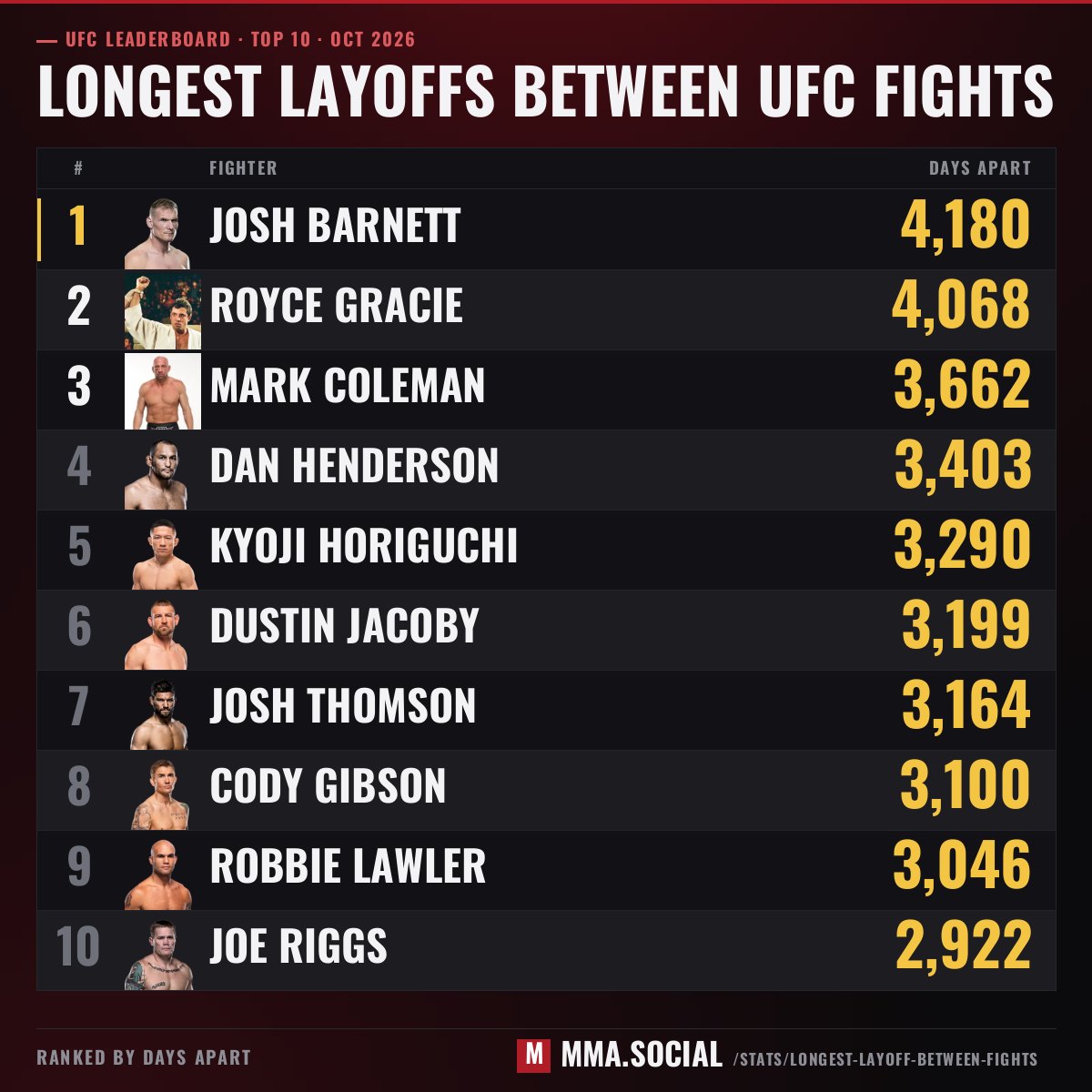
Longest Layoffs Between UFC Fights - top 10 (MMA.SOCIAL): 1. Josh Barnett (4,180), 2. Royce Gracie (4,068), 3. Mark Coleman (3,662), 4. Dan Henderson (3,403), 5. Kyoji Horiguchi (3,290), 6. Dustin Jacoby (3,199), 7. Josh Thomson (3,164), 8. Cody Gibson (3,100), 9. Robbie Lawler (3,046), 10. Joe Riggs (2,922)
Longest Layoffs Between UFC Fights - top 10, updated Oct 30, 2026.
Share image

Longest Layoffs Between UFC Fights: top 10

The top 10 as one image. Free to share, updated after every UFC card.