MMA.SOCIAL

Install MMA.SOCIAL

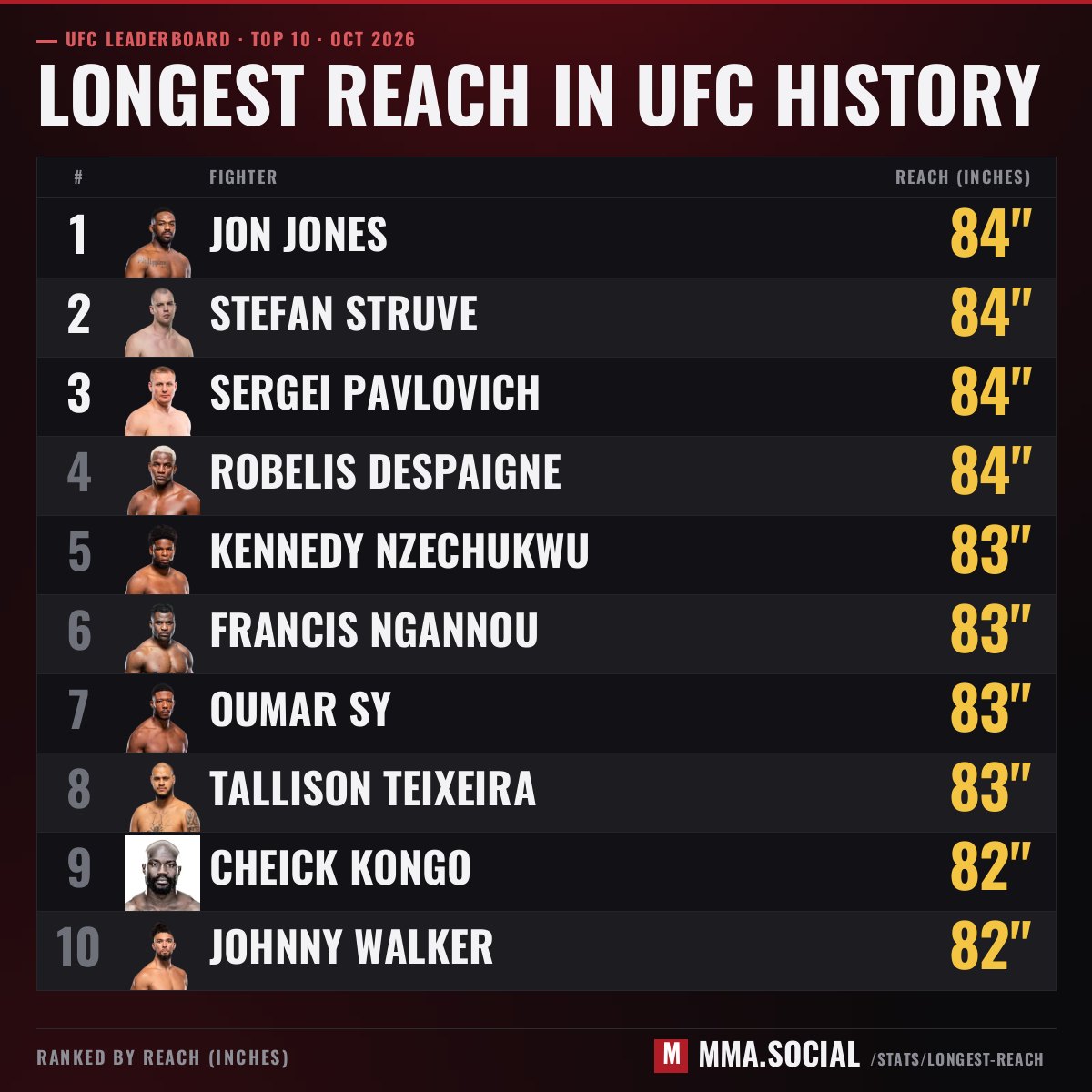
    Longest Reach in UFC History

    Filters All divisions · All time · Men of 1,774

    1
    Jon Jones
    Jon Jones
    84" REACH (INCHES)
    2
    Stefan Struve
    Stefan Struve
    84" REACH (INCHES)
    3
    Sergei Pavlovich
    Sergei Pavlovich
    84" REACH (INCHES)
    4
    Robelis Despaigne
    Robelis Despaigne
    84" REACH (INCHES)
    5
    Kennedy Nzechukwu
    Kennedy Nzechukwu
    83" REACH (INCHES)
    6
    Francis Ngannou
    Francis Ngannou
    83" REACH (INCHES)
    7
    Oumar Sy
    Oumar Sy
    83" REACH (INCHES)
    8
    Tallison Teixeira
    Tallison Teixeira
    83" REACH (INCHES)
    Advertisement
    9
    Cheick Kongo
    Cheick Kongo
    82" REACH (INCHES)
    10
    Johnny Walker
    Johnny Walker
    82" REACH (INCHES)
    11
    Matt Mitrione
    Matt Mitrione
    82" REACH (INCHES)
    12
    Antonio Silva
    Antonio Silva
    82" REACH (INCHES)
    Advertisement
    13
    Mike Rodriguez
    Mike Rodriguez
    82" REACH (INCHES)
    14
    Lavar Johnson
    82" REACH (INCHES)
    15
    Daniel Spitz
    Daniel Spitz
    82" REACH (INCHES)
    2026 Stats

    About Longest Reach in UFC History

    The rangiest fighters on the roster, measured fingertip to fingertip

    Reach is the distance from fingertip to fingertip with the arms outstretched, and it is one of the few physical numbers in the sport that changes how a fight has to be fought. This board ranks every UFC fighter with a recorded measurement, longest first. Height rides on every row, because reach on its own does not tell you much - it is the relationship between the two that decides whether a fighter is genuinely long or simply large.

    Read it inside a division

    The unfiltered top of this list is almost entirely heavyweights, for the obvious reason that bigger people have longer arms. That makes the overall ranking a fact rather than an insight. The division filter is where it gets interesting: an 80-inch reach is unremarkable at heavyweight and extraordinary at welterweight. Use it, and the names that appear are the fighters who actually own a range advantage over the people they fight.

    What is and is not included

    2,477 of the 4,516 fighters on the site have a published reach; the rest carry a placeholder and are excluded rather than being treated as zero. A fighter also needs at least one recorded bout to appear, because the roster contains signed fighters who never competed and a leaderboard led by people who have not fought is not measuring anything. The recorded range across the promotion runs from 58 inches to 84 inches with nothing outside it.

    Pair this with the shortest reach board for the other end of the spectrum, and with the head-to-head compare tool to put two fighters' physical numbers side by side. The full collection lives on the UFC stats hub.

    Frequently Asked Questions

    What is reach in MMA?
    Reach is the span from fingertip to fingertip with both arms held out, measured in inches. It is not the same as height, and the gap between the two is what matters: a fighter whose reach exceeds their height by several inches can fight at a distance their opponent cannot cross, while a fighter whose reach is shorter than their height has to close the gap to do anything at all. Every row here prints the fighter's height next to the figure for exactly that reason.
    Who has the longest reach in the UFC?
    Four fighters share the record at 84 inches: Stefan Struve, Jon Jones, Sergei Pavlovich and Robelis Despaigne. Struve is the extreme case at 7 feet tall, which is where a 84-inch span is simply proportional; Jones is the more remarkable one, carrying the same reach on a 6'4" frame, which is why it was such a weapon at light heavyweight.
    Why is reach missing for so many fighters?
    2,477 of the 4,516 fighters on the site have a recorded reach. The rest are stored as a placeholder because the promotion never published a measurement for them, which is common for fighters who appeared once or twice. Rather than treat a missing measurement as zero, they are excluded from the board entirely. Use the division filter to compare within a weight class, where the numbers are far more meaningful than across the whole roster.
    Does a longer reach mean an advantage?
    Only if the fighter uses it. Reach decides who can hit whom from where, but a rangy fighter who lets an opponent inside has given the advantage away, and a shorter fighter who closes distance well turns it into a liability. It is best read within a division: the top of the overall list is almost entirely heavyweights, simply because bigger people have longer arms. Filter to a weight class to see who is genuinely long for their size.

    Explore More Stats

    Dive into finish rates, division breakdowns, and fighter comparisons

    Stats Hub