MMA.SOCIAL

Install MMA.SOCIAL

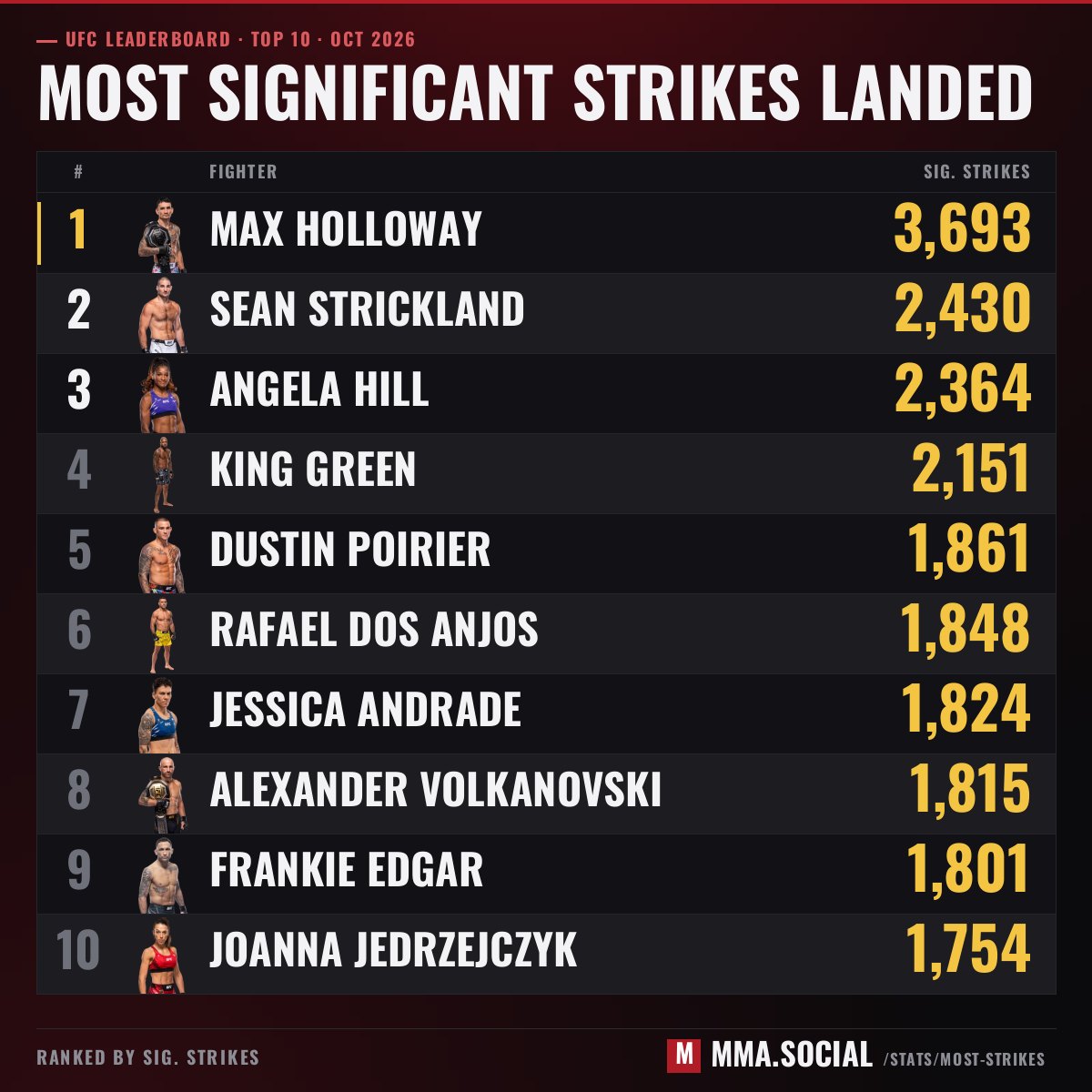
    Most Significant Strikes Landed

    1606
    Clay Harvison 1-2 Welterweight
    75 Sig. Strikes 25.0/fight·48.1% acc
    1607
    Pawel Pawlak 1-2 Welterweight
    75 Sig. Strikes 25.0/fight·33.8% acc
    1608
    Mike Santiago
    Mike Santiago 0-3 Featherweight
    75 Sig. Strikes 25.0/fight·51.0% acc
    1609
    Brok Weaver
    Brok Weaver 1-2 Lightweight
    75 Sig. Strikes 25.0/fight·54.7% acc
    1610
    Justin McCully 2-2 Heavyweight
    74 Sig. Strikes 18.5/fight·37.9% acc
    1611
    Jerome Rivera
    Jerome Rivera 0-4 Flyweight
    74 Sig. Strikes 18.5/fight·28.8% acc
    1612
    Diego Saraiva
    Diego Saraiva 0-3 Lightweight
    74 Sig. Strikes 24.7/fight·32.6% acc
    1613
    Frank Trigg 2-5 Welterweight
    74 Sig. Strikes 10.6/fight·47.1% acc
    Advertisement
    1614
    Francisco Figueiredo
    Francisco Figueiredo 2-2 Flyweight
    73 Sig. Strikes 18.3/fight·61.9% acc
    1615
    Erick Montano
    Erick Montano 1-2 Welterweight
    73 Sig. Strikes 24.3/fight·44.5% acc
    1616
    Jake Hecht
    Jake Hecht 1-2 Welterweight
    72 Sig. Strikes 24.0/fight·47.7% acc
    1617
    Sam Hoger 2-3 Light Heavyweight
    72 Sig. Strikes 14.4/fight·25.0% acc
    Advertisement
    1618
    Shamar Bailey
    Shamar Bailey 1-2 Lightweight
    71 Sig. Strikes 23.7/fight·25.4% acc
    1619
    Herbert Burns
    Herbert Burns 2-4 Featherweight
    71 Sig. Strikes 11.8/fight·36.0% acc
    1620
    Nathan Coy 1-2 Welterweight
    71 Sig. Strikes 23.7/fight·39.4% acc

    The UFC's highest-volume strikers ranked by total significant strikes landed across all tracked fights.

    About Significant Strike Leaders

    This leaderboard ranks UFC fighters by the total number of significant strikes landed across all tracked bouts. Significant strikes include power punches, kicks, knees, and elbows that are thrown with intent to cause damage, as distinguished from jabs or control strikes.

    Key Metrics Explained

    • Total Sig. Strikes Landed: The cumulative number of significant strikes that connected across all fights with available statistics.
    • Per-Fight Average: Average significant strikes landed per bout, indicating a fighter's volume on a per-fight basis.
    • Accuracy %: The percentage of significant strikes attempted that successfully landed. Higher accuracy indicates a more precise striker.
    • Landed / Attempted: The raw count of strikes landed versus total attempts, providing full context for the accuracy percentage.

    Methodology

    Fighters must have a minimum of 3 fights with recorded statistics and at least 100 significant strike attempts to appear on this leaderboard. This ensures statistical relevance and filters out fighters with limited data. All statistics are sourced from official UFC fight stats and updated after each event.

    Limits worth knowing

    A strike total is a count, not a damage score. Every landed significant strike adds one to the tally whether it was a glancing calf kick or the head kick that ended the night, so this board measures output rather than effect. It also says nothing about what a fighter took in return; for that, read it beside the strikes absorbed board.

    Volume is also a function of time in the cage. A fighter who regularly goes 15 or 25 minutes has far more opportunity to accumulate strikes than an equally dangerous finisher who ends fights early, which is why the Per Fight tab is often the fairer read. Per-round statistics are recorded for roughly 8,750 of the 8,800-plus bouts in our database, so a small number of fights, mostly from the earliest era, contribute nothing to any figure here.

    Because a division view counts only the bouts contested at that weight, the figures for anyone who changed division divide between their divisions rather than repeating in each. To rank fighters by quality of opposition rather than raw output, our ELO ratings are the better tool, and each career breaks down in full on the fighter profiles. The rest of our UFC statistics put this number in context.

    Frequently Asked Questions
    What does significant strikes landed actually measure?
    Significant strikes landed counts every power punch, kick, knee, and elbow that connects with intent to damage, excluding jabs flicked at range and control strikes thrown from clinch or ground positions. It is the cleanest single number for gauging a fighter's offensive output, since it filters out the low-impact volume that pads raw total-strike counts.
    Why do high-volume strikers not always have high accuracy?
    Volume strikers throw constantly to overwhelm opponents and dictate pace, which naturally drives their connect rate down as they fire into guards, on the move, and at the edge of range. A pressure fighter landing 35 percent of a huge attempt count can still rack up more total significant strikes than a sniper landing 60 percent of a far smaller sample.
    Why use a per-fight average alongside the career total?
    A career total rewards longevity, so a 20-fight veteran can sit atop the list without being an exceptional per-round volume striker. The per-fight average normalizes for that, exposing which fighters truly flood opponents with output every time they step in versus those who simply accumulated their numbers over many appearances.
    How does fight time affect these strike totals?
    Strike totals are heavily shaped by how long fights last, so finishers who end bouts in the first round often trail decision-heavy fighters who routinely log 15 or 25 minutes of cage time. When comparing two names here, factor in their finishing rates and average fight duration, because more rounds means more opportunities to accumulate significant strikes.