Worst Striking Defense in UFC History

Filters All divisions · All time · Women · 10+ fights

1
Vanessa Demopoulos
Vanessa Demopoulos
40.6% OPP. MISSES
2
Amanda Lemos
Amanda Lemos
44.1% OPP. MISSES
3
Lina Lansberg
Lina Lansberg
44.1% OPP. MISSES
4
Priscila Cachoeira
Priscila Cachoeira
46.0% OPP. MISSES
5
Ashley Yoder
Ashley Yoder
47.0% OPP. MISSES
6
Michelle Waterson-Gomez
48.0% OPP. MISSES
7
Felice Herrig
Felice Herrig
48.1% OPP. MISSES
8
Karol Rosa
Karol Rosa
49.5% OPP. MISSES
Advertisement
9
Joselyne Edwards
Joselyne Edwards
50.0% OPP. MISSES
10
Lucie Pudilova
Lucie Pudilova
50.3% OPP. MISSES
11
Ketlen Vieira
Ketlen Vieira
50.5% OPP. MISSES
12
Ariane da Silva
Ariane da Silva
50.6% OPP. MISSES
Advertisement
13
Pannie Kianzad
Pannie Kianzad
51.4% OPP. MISSES
14
Joanne Wood
Joanne Wood
51.5% OPP. MISSES
15
Mayra Bueno Silva
Mayra Bueno Silva
51.6% OPP. MISSES

Your move

2026 Stats

About Worst Striking Defense in UFC History

Share of opponent significant strikes that missed, lowest first. Minimum 10 measured UFC bouts and 1,000 opponent attempts faced.

This leaderboard ranks UFC fighters by the lowest striking defence: the share of significant strikes thrown at them that missed, counted from the bottom. It is the other end of our best striking defence board and is built from exactly the same arithmetic, the same rollup and the same qualifying gate — at least ten measured UFC bouts and a thousand opponent attempts faced.

Why a low figure is a style, not a verdict

The names here have long careers and plenty of wins between them. A low percentage means a high share of what was thrown found its target, and the most common reason is simply that the fighter chose to be there — pressure fighters and pocket brawlers accept incoming fire as the cost of landing their own, and many of them built successful careers on exactly that trade. Heavyweights appear more often than their numbers should allow, because there is less head movement and less footwork in the division and a greater share of what is thrown lands.

Reading it properly

Because this is a rate rather than a total, pair it with strikes absorbed per minute, which measures the volume of incoming traffic rather than the proportion of it that lands. A fighter low on this board and high on that one was in a great many firefights; a fighter low here but low on volume too was in fewer exchanges and lost most of them. For the opposite side of the same measure see best striking defence, and the full UFC stats hub for output, accuracy and grappling.

Frequently Asked Questions

How is striking defence calculated?
It is the share of the significant strikes thrown at a fighter that missed. A fighter's own stat rows say nothing about what came at them, so the figure is built from the opponent's per-round rows: strikes faced minus strikes landed, divided by strikes faced. This board ranks the lowest percentages, so these are the fighters opponents found easiest to land on.
Does a low percentage mean a fighter is bad?
No, and the board should not be read that way. Look at who is on it: Derrick Lewis, Ed Herman, Tai Tuivasa, Brandon Royval — long UFC careers, plenty of wins, and a shared willingness to stand in front of people. A low figure usually describes a style, not a shortfall. Fighters who plant their feet and trade accept incoming fire as the price of landing their own, and heavyweights are over-represented because there is simply less movement in the division.
Why the minimum of 10 fights and 1,000 strikes faced?
Because it is what keeps this a board about style rather than a pile-on. Loosen the gate and the list fills with fighters who lost a handful of short fights and left the promotion, which says something about their record and nothing about their defence. At ten measured bouts and a thousand attempts faced, every name here has a real UFC career behind the number. It is the identical gate our best striking defence board uses, so the two ends describe the same population.
Is this the same as absorbing a lot of strikes?
Not quite. This is a rate — the proportion of what was thrown that got through. A fighter could have a poor percentage but a short career and a modest absorbed total. For sheer volume of incoming traffic see our strikes absorbed per minute board, which asks a different question and produces a different list.
Why are there so few wrestlers here?
Because a fighter who spends rounds in top position is barely being thrown at, and the strikes that do come are short and awkward. Grapplers therefore drift toward the good end of the scale, and the fighters at this end are almost all strikers who spent their careers in open exchanges.

Every UFC statistics leaderboard

Stats Hub
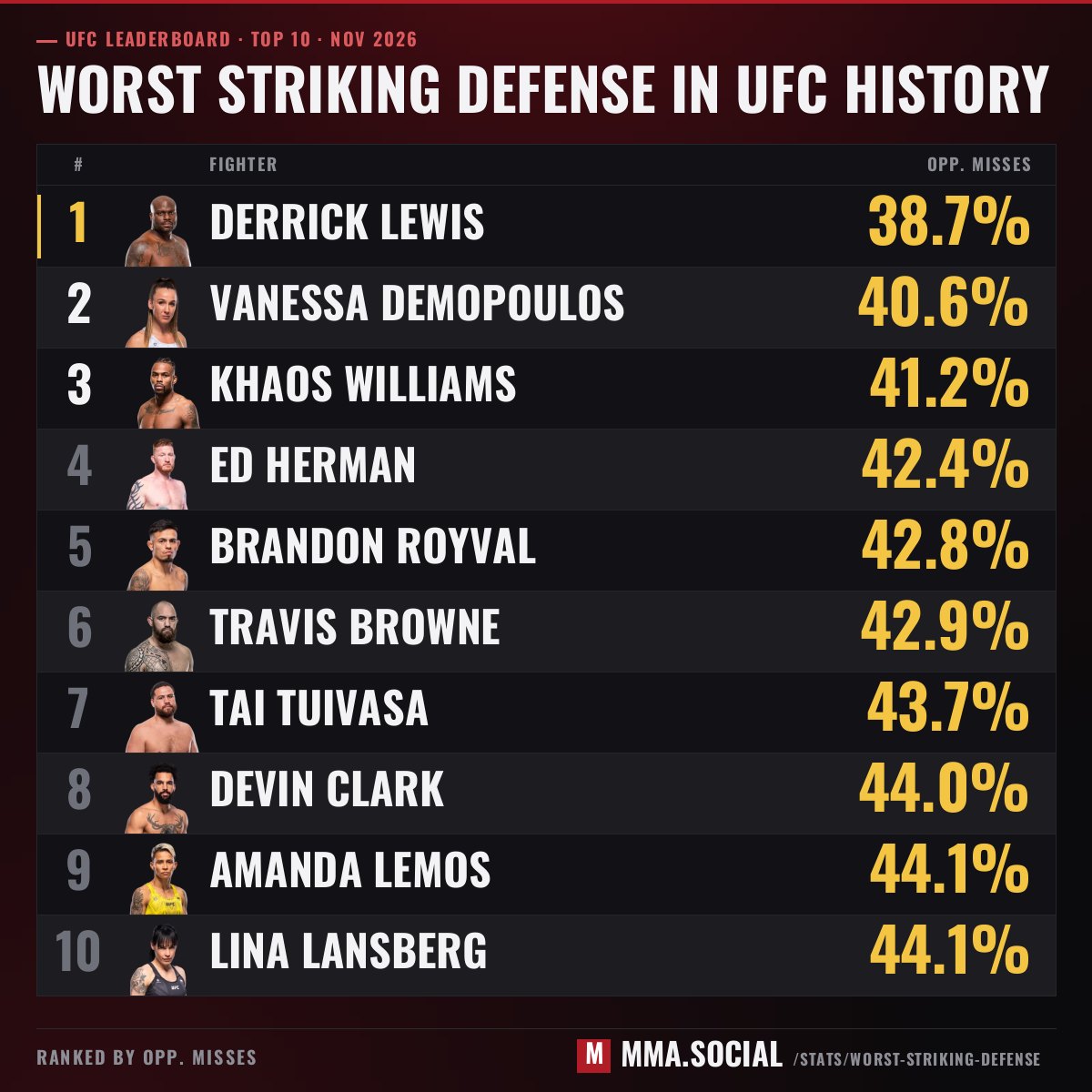
Worst Striking Defense in UFC History - top 10 (MMA.SOCIAL): 1. Derrick Lewis (38.7%), 2. Vanessa Demopoulos (40.6%), 3. Khaos Williams (41.2%), 4. Ed Herman (42.4%), 5. Brandon Royval (42.8%), 6. Travis Browne (42.9%), 7. Tai Tuivasa (43.7%), 8. Devin Clark (44.0%), 9. Amanda Lemos (44.1%), 10. Lina Lansberg (44.1%)
Worst Striking Defense in UFC History - top 10, updated Nov 22, 2026.
Share image

Worst Striking Defense in UFC History: top 10

The top 10 as one image. Free to share, updated after every UFC card.