Most Significant Strikes Absorbed Per Minute

Filters All divisions · All time · Women · 10+ fights

1
Priscila Cachoeira
Priscila Cachoeira
7.45 ABSORBED PER MIN
2
Irene Aldana
Irene Aldana
6.64 ABSORBED PER MIN
3
Vanessa Demopoulos
Vanessa Demopoulos
5.88 ABSORBED PER MIN
4
Karolina Kowalkiewicz
5.77 ABSORBED PER MIN
5
Roxanne Modafferi
Roxanne Modafferi
5.72 ABSORBED PER MIN
6
Jessica Andrade
Jessica Andrade
5.58 ABSORBED PER MIN
7
Ji Yeon Kim
Ji Yeon Kim
5.41 ABSORBED PER MIN
8
Felice Herrig
Felice Herrig
5.19 ABSORBED PER MIN
Advertisement
9
Lauren Murphy
Lauren Murphy
5.19 ABSORBED PER MIN
10
Angela Hill
Angela Hill
5.00 ABSORBED PER MIN
11
Bethe Correia
Bethe Correia
4.93 ABSORBED PER MIN
12
Maryna Moroz
Maryna Moroz
4.89 ABSORBED PER MIN
Advertisement
13
Joanne Wood
Joanne Wood
4.89 ABSORBED PER MIN
14
Viviane Araujo
Viviane Araujo
4.83 ABSORBED PER MIN
15
Tabatha Ricci
Tabatha Ricci
4.79 ABSORBED PER MIN

Your move

2026 Stats

About Most Significant Strikes Absorbed Per Minute

Significant strikes absorbed per minute of octagon time - minimum 5 fights and 35 minutes of cage time

This leaderboard ranks UFC fighters by significant strikes absorbed per minute of octagon time — the mirror of our strikes landed per minute board. Every significant strike an opponent has landed on the fighter is summed across their career, alongside every second they have actually spent in a live fight, and one is divided by the other. Fighters qualify with at least five scored fights and 35 minutes of recorded cage time.

How the per-minute normalisation works

Fight time is taken from the round and clock time at which each bout ended, so a fight stopped at 2:30 of round two counts as seven and a half minutes rather than ten. Career seconds and career absorbed strikes are each summed before the division is performed, which makes the figure a true time-weighted rate rather than an average of averages — without that, a thirty-second knockout would weigh as heavily as a twenty-five-minute title fight.

What a high number actually means

It means a lot of traffic came the other way, and there is more than one route to that. Pressure fighters who close distance and trade in the pocket absorb heavily by design, and so do fighters who were consistently matched against sharper strikers. The figure does not distinguish between the two, which is why it is worth reading beside the offensive board: a fighter who is high on both was in genuine firefights, while a fighter high here and low there was being out-struck. Grapplers sit near the bottom almost automatically, because time spent in top position is octagon time in which nothing is landing.

The other end of this scale is fewest strikes absorbed per minute. For the defensive side of the same exchange see striking defence, which measures the share of incoming strikes that miss, and takedown defence for the grappling equivalent. The full UFC stats hub covers output, accuracy and finishing.

Frequently Asked Questions

What does strikes absorbed per minute mean?
It is how many significant strikes an opponent lands on a fighter for every minute that fighter is in a live fight. We total every significant strike landed against them across their career, total the real seconds they have actually spent fighting, and divide. A fighter at 6.00 is being hit six times a minute, which is ninety times over a full three-round fight. This is the measure the UFC publishes as SApM.
Does a high number mean a fighter is bad?
No, and the board should not be read that way. There are two very different careers near the top. One belongs to pressure fighters who accept damage on the way in because their game is to close distance and trade — they take a lot because they are always in range. The other belongs to fighters who were routinely matched against better strikers. The number alone does not tell you which, so read it against our strikes landed per minute board: someone high on both was in firefights, someone high here and low there was on the wrong end of them.
Why normalise by time instead of counting total strikes absorbed?
Because raw totals reward longevity rather than describing a style. A twenty-fight veteran will have absorbed more strikes than a five-fight prospect even if the prospect is hit twice as often per minute. Dividing by octagon time removes career length from the figure entirely and isolates how much traffic a fighter takes while the fight is actually live.
Why are there two minimums instead of one?
Because a fight-count floor alone is not enough for a rate. A fighter with five quick losses might have only ten minutes of recorded octagon time, and a burst of strikes across those ten minutes projects to an enormous per-minute figure. Requiring 35 minutes of cage time as well as five scored fights means everyone here has sustained it over more than two full fights' worth of action. The same double floor is used on strikes landed per minute, fewest strikes absorbed per minute and takedowns per minute, so all four boards agree about who qualifies.
Why do wrestlers barely appear?
Because a fighter who spends the round in top position is not being struck. Time on the mat counts as octagon time but produces almost no incoming strikes, which pushes grapplers to the bottom of this board and strikers to the top. It is a fair description of what happened in those fights, but it means the board measures traffic taken rather than defensive skill on its own.

Every UFC statistics leaderboard

Stats Hub
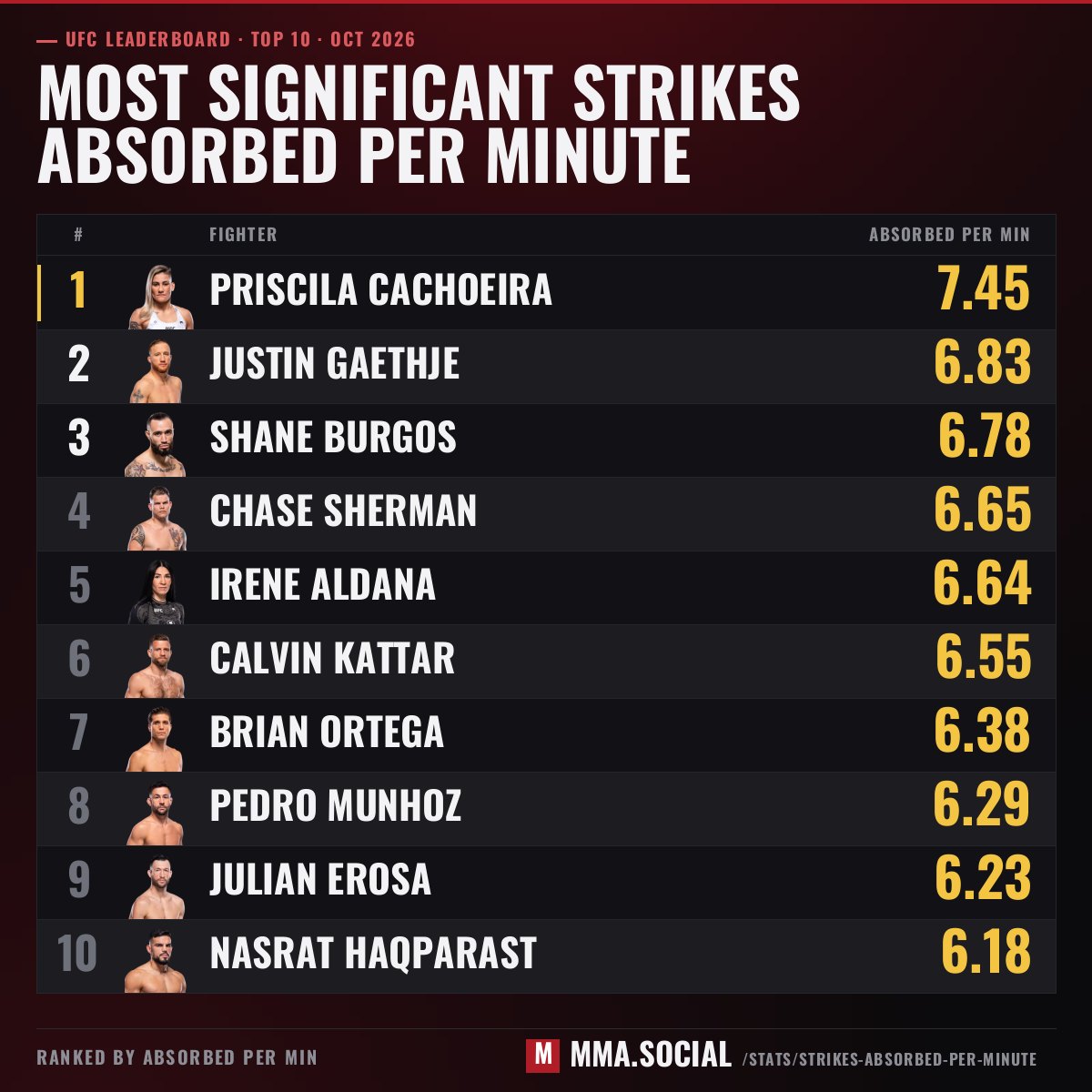
Most Significant Strikes Absorbed Per Minute - top 10 (MMA.SOCIAL): 1. Priscila Cachoeira (7.45), 2. Justin Gaethje (6.83), 3. Shane Burgos (6.78), 4. Chase Sherman (6.65), 5. Irene Aldana (6.64), 6. Calvin Kattar (6.55), 7. Brian Ortega (6.38), 8. Pedro Munhoz (6.29), 9. Julian Erosa (6.23), 10. Nasrat Haqparast (6.18)
Most Significant Strikes Absorbed Per Minute - top 10, updated Oct 25, 2026.
Share image

Most Significant Strikes Absorbed Per Minute: top 10

The top 10 as one image. Free to share, updated after every UFC card.